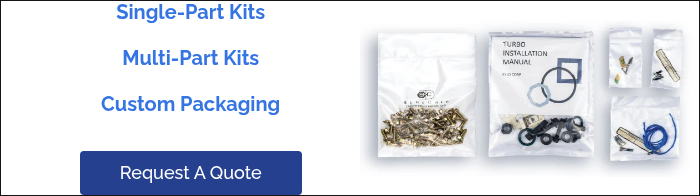
Most manufacturers focus on piece price, but fastener kitting is one of the fastest ways to cut the total installed cost of every assembly you build.
By combining engineered kits with Blue Chip’s Vendor Managed Inventory (VMI), you can take real cost out of labor, errors, changeovers, and downtime—without starving your lines of critical hardware.
Why Part Price Is Only 20% Of The Story
When you look at your fastening spend, the fastener itself is often the smallest slice of the pie; the hidden 80% lives in handling, walking, counting, changeovers, rework, and waiting time at the line. Total Installed Cost accounts for all of that: the complete cost of getting the right fastener from packaging into a finished, quality assembly.
Blue Chip Engineered Products focuses on building relationships and solving problems, not just quoting parts, so our kitting and VMI programs are designed around your Total Installed Cost, not the cheapest bolt on the spreadsheet. By involving us early in the design process, we can help you specify the right specialty fasteners, design efficient kits, and schedule replenishment to support your takt time.
1. Cutting Non‑Value‑Added Labor At The Line
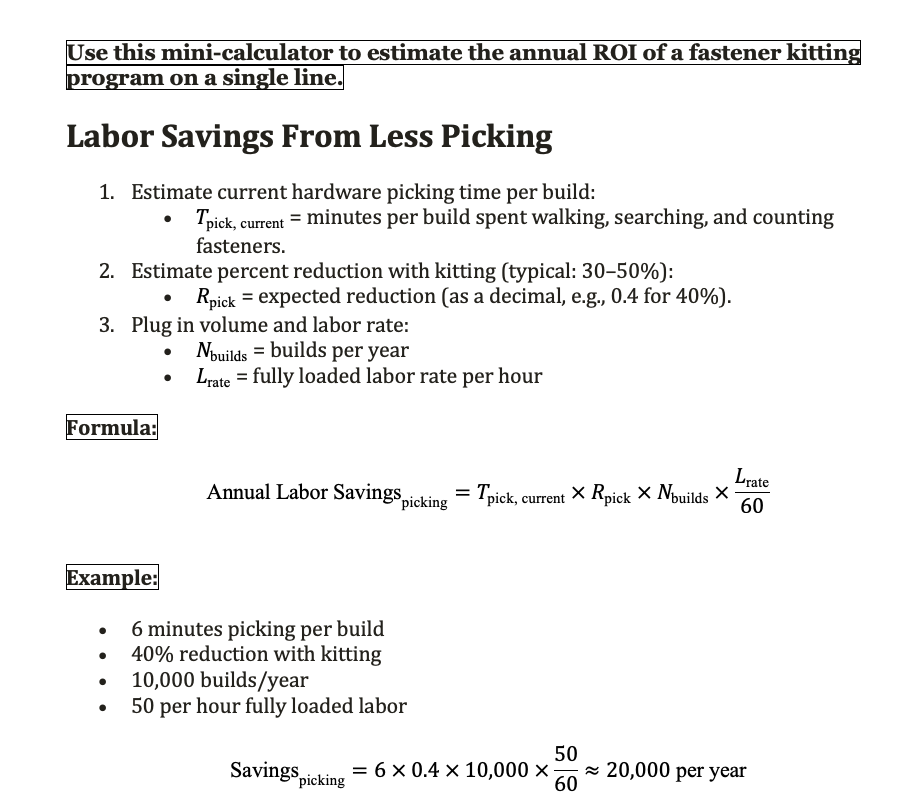
Every minute your assemblers spend walking to bins, counting small parts, or hunting for the “right” washer is a minute they are not building product. Studies on kitting in high‑variation assembly lines show that pre‑sorted, point‑of‑use kits significantly reduce retrieval time and handling effort. When kits arrive at the station with exactly what is needed for that job, operators can stay focused on value‑added work.
Imagine an assembler currently spends 6 minutes per job gathering hardware, with 40 jobs per shift—that is 4 hours of non‑value‑added time every day. If a well‑designed kitting program cuts that time in half, you gain 2 additional productive hours per shift, or roughly 500 hours per year on a single line. Blue Chip’s automated packaging and print‑to‑part expertise let us build kits that mirror your actual build sequence so operators simply open, install, and move on.
2. Fewer Picking Errors And Less Rework
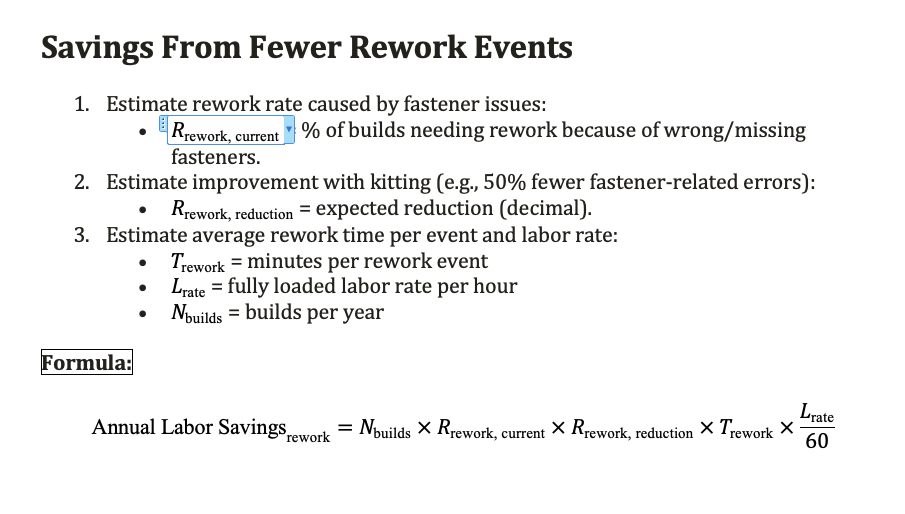
Picking errors are expensive: the wrong bolt or a missing nut can drive scrap, rework, delays, and even field failures. Lean kitting case studies show that standardized kits, clear labeling, and visual instructions can sharply reduce mis‑picks and shortages. When each build uses a single kit instead of a dozen open bins, there are fewer opportunities to grab the wrong part.
If 1% of your assemblies require rework due to fastener issues and each incident consumes 20 minutes of technician time, cutting those errors by half can return 150–300 labor hours per year on a modest line. Blue Chip can include your logo, barcodes, data matrix codes, and detailed content descriptions on each kit, and we can insert instruction sheets tailored to your work instructions to further error‑proof the process.
3. Faster Changeovers With Pre‑Staged Kits
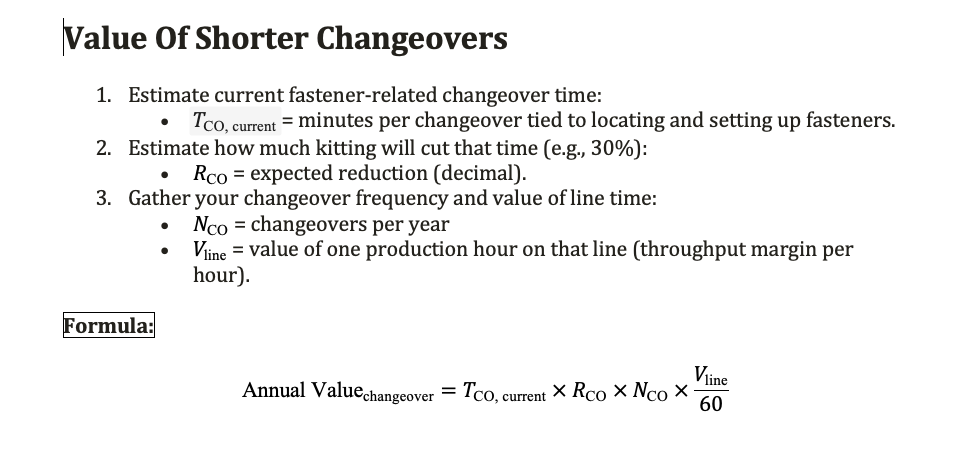
Changeover time directly impacts Overall Equipment Effectiveness (OEE), especially in high‑mix environments. Best‑practice changeover methods (like SMED) emphasize pre‑staging materials and separating external activities from internal ones. Pre‑kitted fasteners support that approach by ensuring the next job’s complete hardware set is ready at the line before the changeover begins.
Suppose fastener‑related tasks add 10 minutes to each setup and you perform 15 changeovers per week. Reducing that time by even 30% with pre‑staged kits gives you back 75 minutes of production time each week—equivalent to roughly one extra shift of capacity every month. Blue Chip’s Solve. Source. Schedule. Service. model and VMI capabilities mean those kits can be built and sequenced to your manufacturing schedule, so operators never wait on hardware to start the next run.
4. Reducing Line Downtime From Stock‑Outs
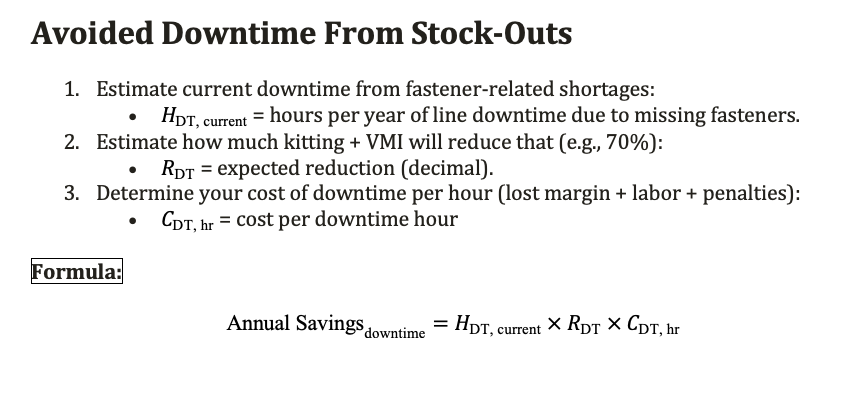
Nothing is more frustrating than a fully staffed line sitting idle because a 5‑cent part is missing. Traditional fastener programs rely on manual counts and periodic orders, which often result in either excess inventory or unexpected stock‑outs. With an integrated kitting and VMI program, inventory responsibility shifts to Blue Chip, and kit components are monitored using electronic scales, RFID, and barcode scanning.
Even losing 10 minutes per week to fastener‑related stoppages adds up to more than 8 hours of lost production per year; if your fully loaded line hour is $2,000, that is a $16,000 annual impact before considering late shipments or expedited freight. Blue Chip builds and stocks thousands of kits daily and uses data‑driven software to ensure the right number of kits is available, so your team has peace of mind that fasteners will not be the reason a line goes down.
5. Lower Material‑Handling And Warehouse Costs
Without kitting, fasteners often create a long tail of small SKUs that must be received, stored, picked, and replenished individually. Kitting consolidates many of those SKUs into kit SKUs, simplifying receiving, counting, and lineside storage. Material‑handling studies consistently show that reducing touches and walking distances can deliver double‑digit reductions in indirect labor.
If each fastener SKU is touched 3–4 times from dock to line today, and a kitting program cuts those touches in half, the labor tied up in internal logistics falls accordingly. With Blue Chip’s VMI program, inventory levels are set based on your historical and projected demand, and parts are stocked for release per your manufacturing schedules, further reducing the burden on your warehouse.
6. Simplified Training And More Flexible Staffing
Complex, bin‑based hardware setups demand tribal knowledge—operators need to remember which bin holds which rev level, material, or finish. Lean kitting implementations show that when part picking is moved upstream and kits are standardized, training time for new assemblers drops and cross‑training becomes easier.
If it currently takes four weeks to bring a new assembler to full productivity, and clear, standardized kits shorten that ramp‑up to three weeks, you have effectively reduced training time by 25% while getting capacity online faster. Blue Chip can integrate visual labels, color coding, and detailed contents into kit packaging, and our engineering team can collaborate with yours to align kit design with your standard work and visual management practices.
7. Better Data And Continuous Improvement On Fastener Spend
You cannot improve what you cannot measure. When fasteners are consumed as loose parts, it is difficult to see exactly where time is lost or where specific components create problems. With structured kits and VMI, usage data can be captured at the kit level, making it easier to identify over‑consumption, recurring shortages, or opportunities for hardware standardization.
For example, analyzing kit consumption may reveal that two similar fasteners can be standardized to a single part number, which not only increases purchasing leverage but also simplifies kitting and assembly. Blue Chip’s VMI platform leverages electronic scales, RFID, and advanced software to track inventory and support data‑driven adjustments to kit design, reorder points, and stocking strategies—turning your kitting program into a continuous‑improvement engine.
From “Cheapest Bolt” To Lowest Total Installed Cost
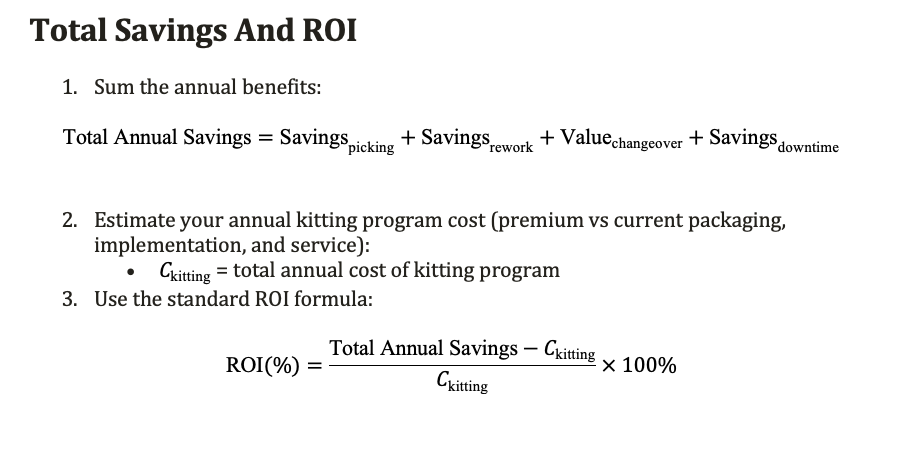
Focusing only on fastener piece price can cause you to overlook the much larger costs hiding in labor, errors, changeovers, and downtime. A thoughtfully engineered fastener kitting program—backed by Blue Chip’s ISO‑certified VMI, automated packaging, and print‑to‑part expertise—slashes Total Installed Cost by attacking all of those drivers at once.
If you are ready to see what this looks like in your plant, share a representative bill of materials and build cycle with our team, and we will walk you through a fastener‑kitting ROI scenario tailored to your line.
To dive deeper into how Vendor Managed Inventory transforms fastener supply chains, explore our Fasteners 101 resources on Understanding Vendor Managed Inventory and How VMI Transforms Fastener Supply Chains.