
Vendor-Managed Inventory Isn't About the Vendor — It's About Eliminating Your Inventory Problem
Quick summary: Vendor-Managed Inventory (VMI) is often marketed as a vendor convenience program, but for manufacturers, its real value is eliminating stockouts, excess safety stock, and unpredictable lead times before they happen.
This post explains what VMI actually solves, how Blue Chip Engineered Products structures VMI programs using electronic scales, RFID, and wireless tracking, and why the right question isn't "which vendor manages my inventory" but "who is eliminating my inventory problem entirely."
Read on for a Q&A breakdown of how VMI works, what it costs to skip it, and an FAQ section answering the most common buyer questions.
Isn't VMI Just a Vendor Convenience Program?
No — that's the most common misconception about vendor-managed inventory. VMI is often pitched as a way for suppliers to lock in recurring orders, but from a buyer's side, the value has nothing to do with vendor convenience. It's about removing the operational burden of tracking, forecasting, and reordering fasteners from your team entirely, so purchasing and production stop firefighting stockouts and excess inventory.
What Inventory Problem Is VMI Actually Solving?
Most manufacturers don't have a "vendor relationship" problem — they have an inventory visibility problem. Without a system in place, teams either over-order to avoid running out (tying up cash and warehouse space) or under-order and risk a line-down event.
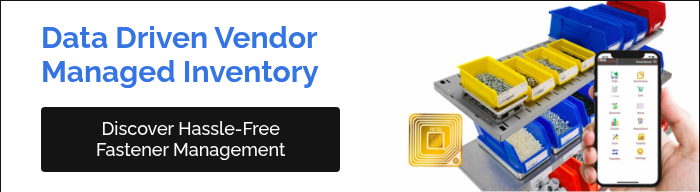
Blue Chip's approach uses electronic scales, RFID, and wireless technology powered by data-driven software to give real-time visibility into exact stock levels, so there's no guessing on either side. That data feed is what eliminates the problem—the vendor relationship is just the mechanism that delivers it.
Why Does "Who Manages the Inventory" Matter Less Than "How Is It Managed"?
Buyers often shop for VMI programs by comparing vendors, but the more important question is what process sits behind the label. Blue Chip structures every VMI program around a four-part approach: Solve, Source, Schedule, Service.
Solve means getting involved early in design to prevent inventory issues before they start.
Source means tapping a global network of ISO-certified manufacturers so supply isn't dependent on a single production line.
Schedule means using blanket purchase agreements and yearly inventory purchases to eliminate long lead times and large minimum buys.
Service means an experienced team that continuously adjusts the program as your goals change.
A vendor name on the contract doesn't guarantee any of that — the process does.
How Does This Compare to Just-in-Time Inventory?
VMI and just-in-time (JIT) delivery are often discussed as competing strategies, but they're solving overlapping problems from different angles.
JIT minimizes on-hand inventory by timing deliveries closely to production needs, while VMI shifts the ongoing monitoring and replenishment decision to the supplier.
For a deeper side-by-side comparison, see Vendor Managed Inventory or Just-in-Time. In practice, many Blue Chip customers combine both: JIT-style scheduled releases layered on top of a VMI data feed, which reduces cash tied up in inventory without introducing stockout risk.
What Does It Cost to Not Fix the Inventory Problem?
Skipping a real VMI program doesn't save money — it just moves the cost somewhere less visible. Manual tracking and reactive ordering typically show up as emergency freight charges, production downtime waiting on parts, or excess safety stock sitting in a warehouse.
Blue Chip's kitting and packaging capabilities can compound these savings further by combining multiple parts into pre-built kits with barcode or data matrix coding, cutting the labor cost of receiving and staging inventory on top of the ordering savings.
Learn more about how kitting reduces total cost as a companion strategy to VMI.
Who Should Actually Be Evaluating a VMI Program?
This isn't just a purchasing department decision. Production managers who deal with line-down risk, finance teams tracking working capital tied up in inventory, and quality teams who need consistent ISO-certified supply all have a stake in how VMI is structured.
If a VMI conversation happens only at the price-per-piece level, it misses the actual problem being solved.
FAQ: Vendor Managed Inventory for Fasteners


